
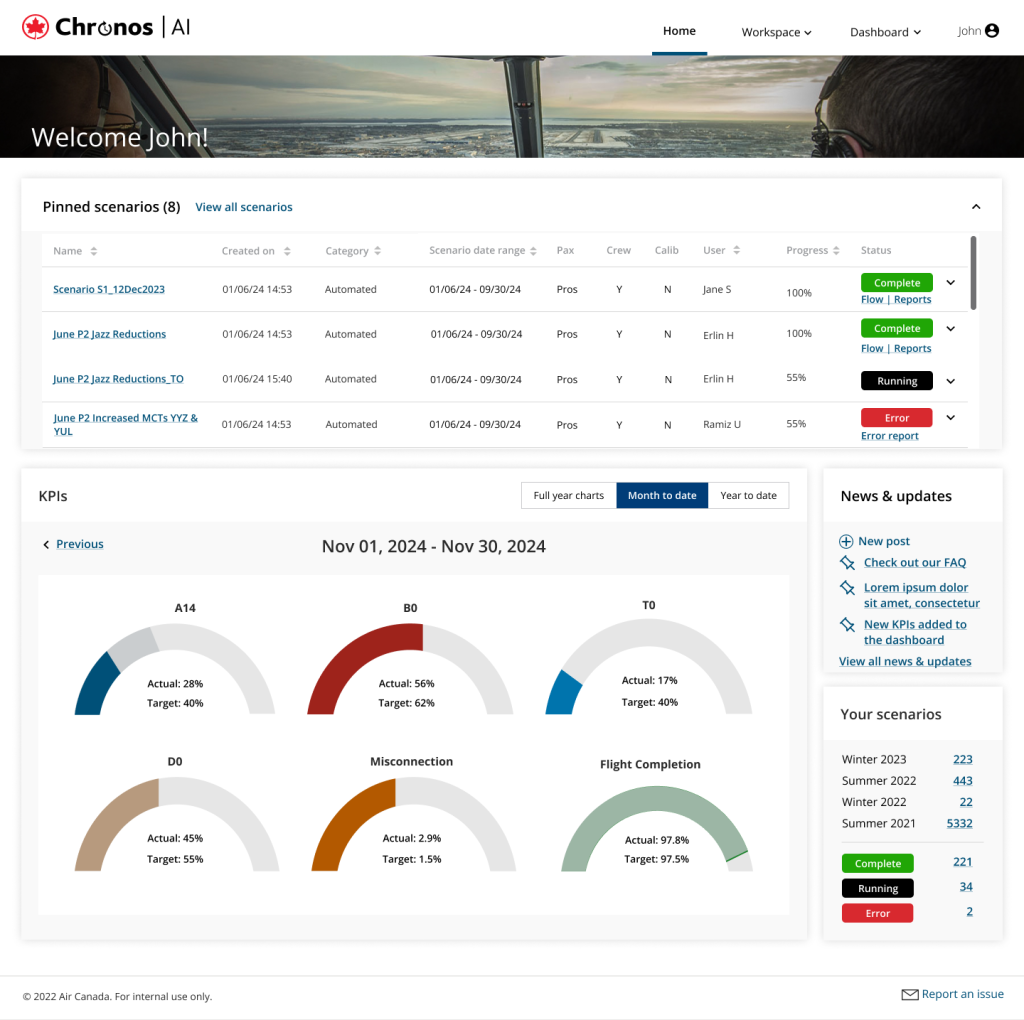
Air Canada – On-Time Performance Application
This project exemplified my ability to humanize artificial intelligence, turning predictive analytics into practical, trusted decision tools.
By grounding design in empathy, field observation, and accessibility, we helped Air Canada move from reactive operations to data-driven, proactive performance management, showing how design can bridge the gap between machine intelligence and human judgment.
Project Overview
Air Canada’s Operations team needed an intelligent, real-time application to monitor and improve on-time flight performance across its global network.
The goal was to design a data-driven, AI-powered platform that could anticipate delays, recommend proactive interventions, and help operations leaders coordinate resources efficiently, all through an intuitive, explainable interface.
The project brought together data scientists, operations analysts, and product teams to translate predictive machine-learning models into usable, human-centered insights for dispatchers, maintenance leads, and airport operations staff.
The Challenge
Airline operations are complex, with hundreds of interdependent factors affecting on-time performance, weather, crew scheduling, maintenance status, aircraft routing, and gate logistics.
Before this initiative, data and insights were scattered across multiple legacy tools, dashboards, and spreadsheets. The challenge was to turn AI predictions into actionable decisions, enabling operations staff to see, trust, and act on insights in real time.
We needed to bridge three difficult gaps:
Technical: Translate ML model outputs into interpretable, user-friendly formats.
Operational: Design workflows for fast-paced environments where seconds matter.
Human: Build trust in AI recommendations through clarity, transparency, and explainability.
Design Process
Discovery & Research
Conducted field research and contextual interviews with dispatchers, station managers, and operations controllers to map how delay decisions were made today.
Partnered with data scientists to understand machine-learning model capabilities and the variables influencing OTP predictions.
Synthesized insights into personas, service blueprints, and user journey maps representing decision flows across the network.
Accessibility & Testing
Facilitated usability sessions with cross-functional teams under real-world operational conditions.
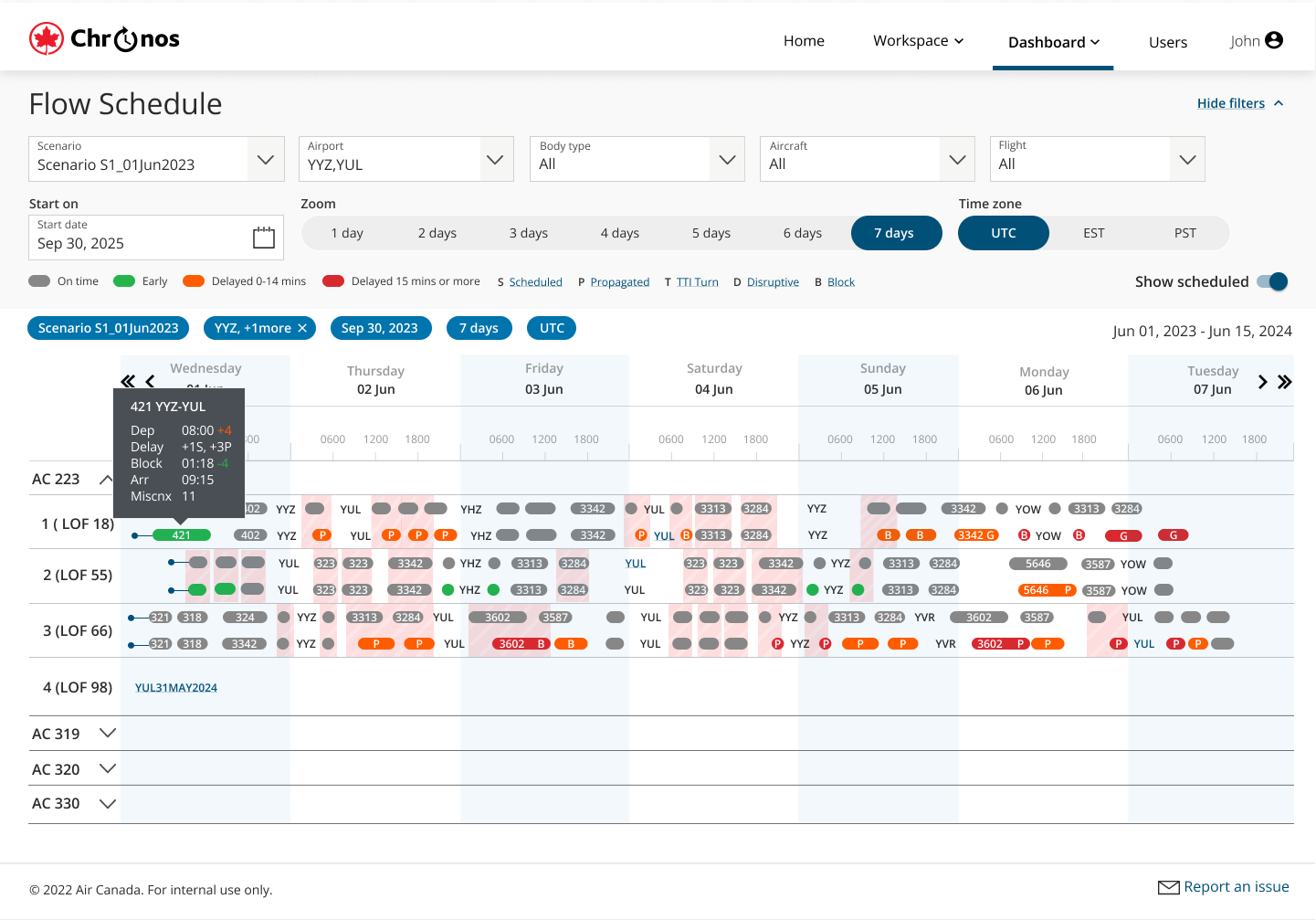
Applied WCAG 2.1 AA accessibility standards, ensuring dashboards were usable on multiple screen types and assistive technologies.
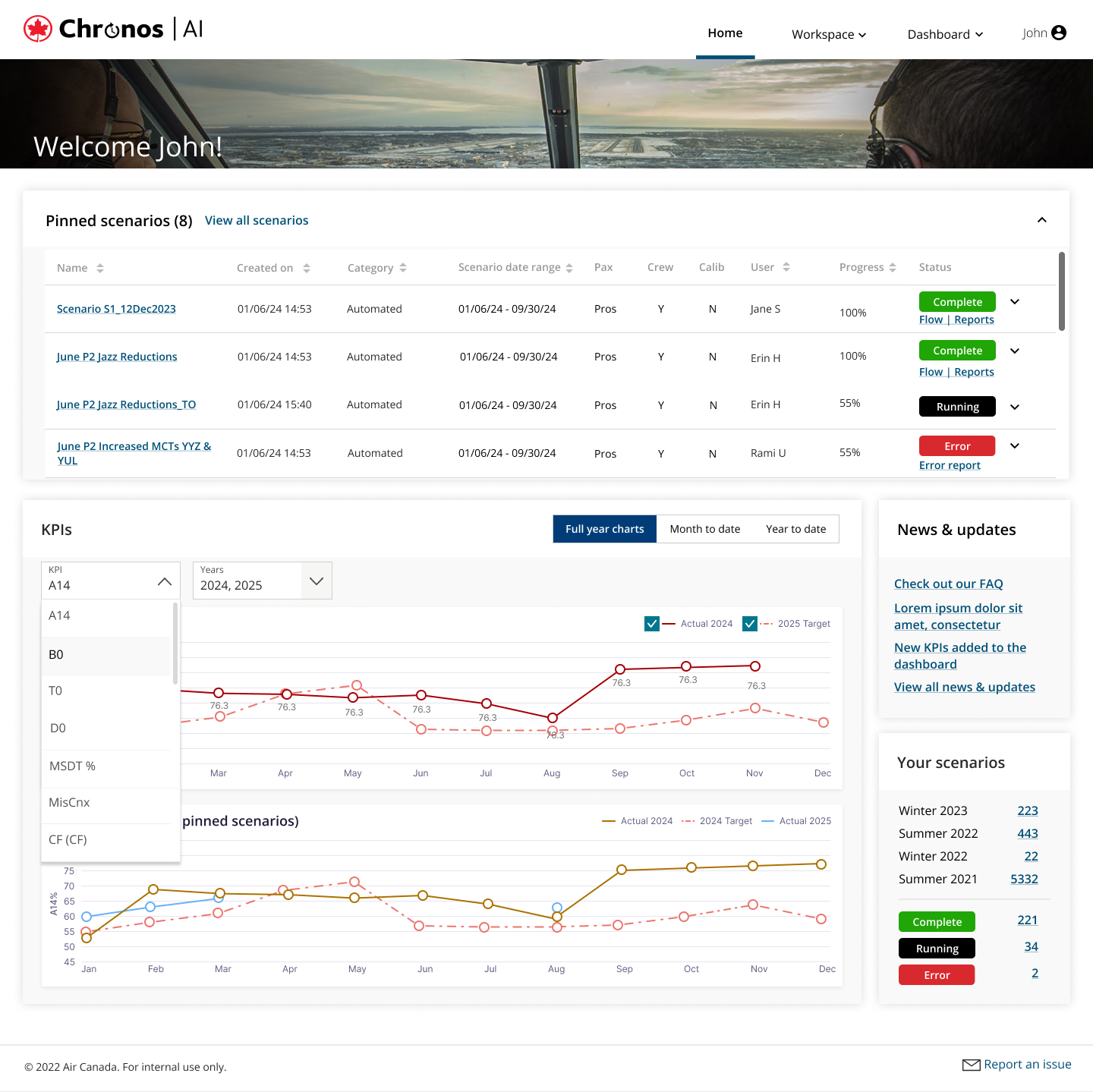
Iterated on visual encoding (color, shape, text) to make predictive data understandable under time-sensitive conditions.
Experience Strategy
Defined the core design challenge: enable teams to quickly understand why a delay might occur, how confident the system is, and what actions can prevent it.
Developed information architecture and dashboard hierarchies prioritizing early warnings, root-cause analytics, and real-time status views.
Created a trust framework for AI, emphasizing transparency (“confidence levels,” “factors contributing to delay”) over black-box predictions.
Collaboration & Delivery
Worked within Agile sprints in MS DevOps to manage stories, backlog items, and user requirements.
Partnered closely with architects, developers, and QA to ensure data fidelity and interface responsiveness across deployments.
Defined service-level success metrics (prediction accuracy, decision latency, and user trust indicators) to measure post-launch adoption.
Design & Interaction
Tools: Figma • FigJam • Miro • Power BI Integration • Azure ML
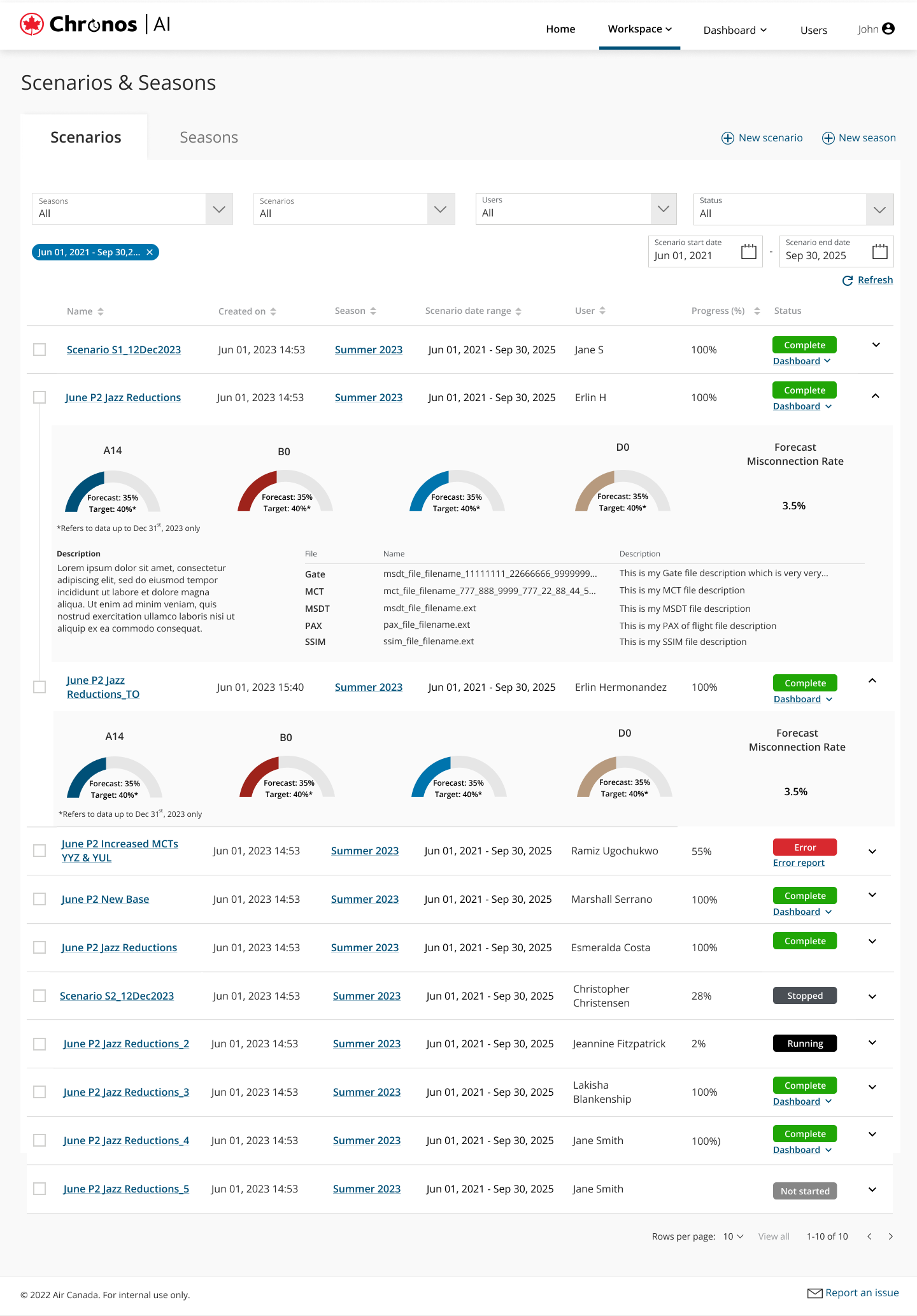
Designed interactive dashboards visualizing flight networks, delay probabilities, and mitigation options.
Created what-if simulation tools allowing users to test alternate crew or gate scenarios.
Built data cards and alert panels that surfaced only relevant actions, reducing cognitive overload in high-pressure environments.
Prototyped in Figma and FigJam, integrating with Air Canada’s internal design system and Microsoft Azure data pipelines.
Outcomes & Impact
Delivered Air Canada’s first AI-powered operational performance dashboard, providing real-time predictive visibility across the network.
Reduced average delay-response time by 20–25%, enabling proactive scheduling and resource reallocation.
Increased trust in AI insights through clear design of confidence indicators and contextual explanations.
Achieved full WCAG 2.1 AA compliance for accessibility across desktop displays in the operations center.
Established a reusable design pattern library for predictive applications, now referenced in subsequent AI initiatives within Air Canada.
Let’s build something great together.
We can help you uncover new opportunities, design smarter solutions, and create digital experiences that drive real business impact.
We’ve helped organizations improve their bottom line by combining deep usability and user experience design expertise with a strong foundation in technical principles.
Your information is confidential. We will never share it with anyone.