
Entanglement: A Challenge to the Logic of Separate Things
Introduction
Superposition already challenges our ordinary perception of reality by suggesting that a quantum system can inhabit multiple possible states before measurement. Yet entanglement presents an even more fascinating idea. It suggests that the deepest reality of a system may not reside in its individual parts, but in the relationships that bind those parts into a single shared state. That is what makes entanglement one of the most consequential ideas in quantum computing: it does not only expand what computers may be able to do but asks us to reconsider how a system can be understood in the first place.
Entanglement is often introduced as one of the strangest features of quantum mechanics, and perhaps it is. But what makes it important is not only its strangeness. Entanglement describes a situation in which two or more quantum objects can no longer be fully described on their own. They do not simply interact and then return to separateness. Instead, they become part of a single shared state, such that the meaningful description belongs to the whole rather than to the individual parts in isolation.
That may sound abstract at first, but the idea reaches further than abstraction. It has consequences not only for physics, but for how we think about information, complexity, and the limits of the models we inherit from classical reasoning. In that sense, entanglement matters not just because it is useful, but because it quietly unsettles some of our deepest assumptions about what it means to explain a system.
Entanglement Challenges the Classical View of Separate Parts
Classical thought is based on a very reliable methodology: when faced with complexity, we break the system into smaller pieces, understand each part, and then reconstruct the whole. This methodology served science, engineering, and management remarkably well.
In an entangled quantum system, the most important information is not always stored in the individual components. Rather, it can reside in the relationship between them. Even when particles or qubits are physically separated, the system may still resist any description that treats them as independent entities. What matters is not only what each part is, but what the parts are together.
This helps explain why entanglement was historically so difficult to accept. Albert Einstein famously described it as “spooky action at a distance”, not because he was drawn to the mystical, but because he was resisting a picture of reality that seemed to violate the classical ideal of local, self-contained properties. The discomfort was philosophical as much as scientific. If the world could not always be understood in terms of separate things with separate states, then the conceptual ground of physics itself seemed less stable than many had assumed.
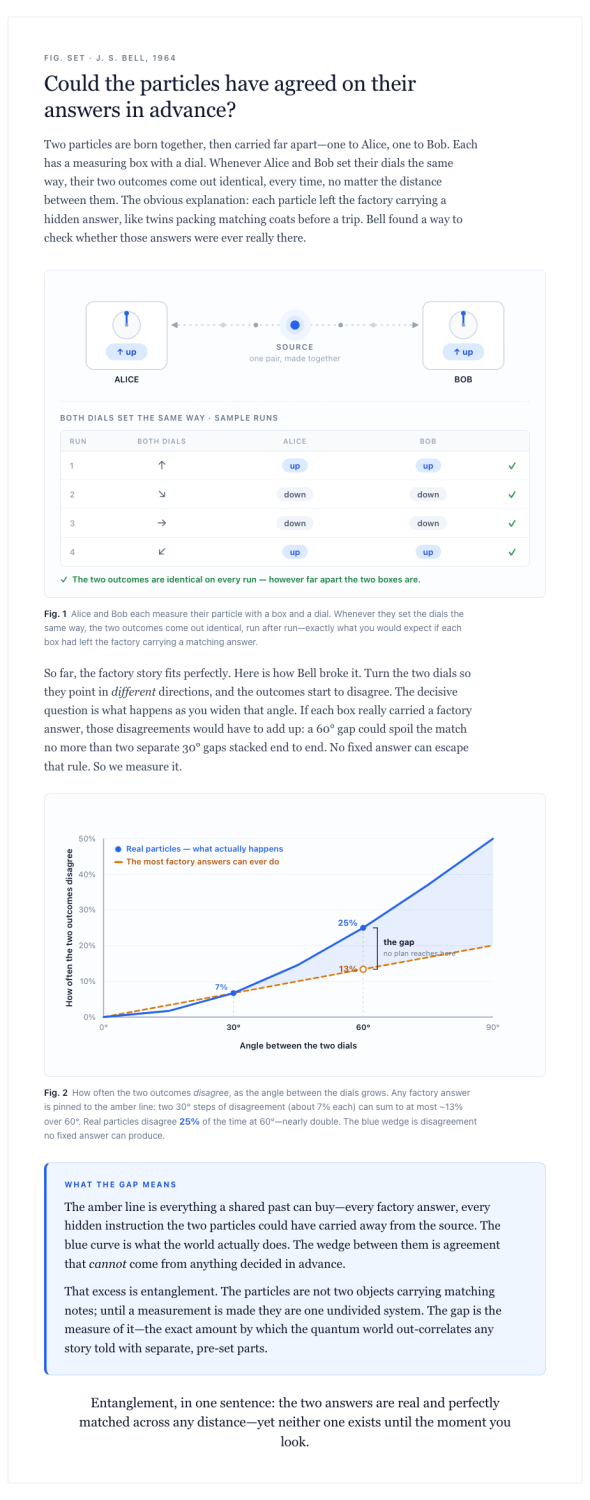
Figure 1–2. Bell’s theorem in two steps: when Alice and Bob measure the particles the same way, their results match; when the angles differ, real outcomes diverge faster than any hidden-answer model can explain.
Yet later work, especially Bell’s theorem and the experiments that followed, made it increasingly difficult to dismiss entanglement as a mere conceptual oddity. It proved to be a real feature of quantum systems, and once accepted on those terms, it became clear that entanglement was not simply an exception to the rule. It was evidence that the rule itself had limits.
Why Entanglement Matters in Quantum Computing
In quantum computing, entanglement matters because it changes what information can be and where that information can meaningfully reside.
In a classical computer, information is stored in bits that can, at least in principle, be described individually. The state of the system is assembled from the states of its parts. A quantum computer operates differently. When qubits become entangled, some of the meaningful structure of the computation belongs not to any one qubit but to their joint state. In other words, the system carries information in patterns of relation as much as in discrete units.
That distinction matters because many difficult problems are not fundamentally about isolated variables. They are about relationships, dependencies, and constraints. Molecular modelling, financial systems, logistics, optimization, or cryptography are not simply collections of separate elements sitting side by side. They are architectures of interaction, shaped by dependencies that can become difficult to represent cleanly as the system grows. Classical computing can be exceptionally good at modelling such structures, but not always efficiently. This task becomes even more difficult as the intricacy of the relationships involved increases.
Quantum systems are different because relational structure is embedded in the physics itself. This is one reason entanglement is not just a curious feature of quantum computing that is confined to the edge of theory. It is one of the field’s core principles. To understand quantum advantage at all, one must take seriously the possibility that some forms of computation become tractable only when relation, rather than separateness, is treated as fundamental.
The Key Takeaway: Some Systems Cannot Be Understood Through Fragmentation
The significance of entanglement does not end with quantum physics. Part of what makes it so intellectually controversial is that it offers a disciplined reminder about the nature of complexity. We often assume that understanding improves as analysis becomes more granular. But there are cases in which fragmentation removes the very structure that gives the system its meaning. If the key property exists in the relation, then isolating the parts can leave us with something more manageable, yet less real.
That insight extends well beyond science. In fields such as leadership, strategy, design, and systems thinking, the most important challenges rarely reside within isolated units. They emerge through patterns of interdependence: risk takes shape through connection, resilience depends on coordination, and failure often travels along relationships rather than arising from any single weak point. In such cases, what matters most is not only the quality of the individual parts, but the structure of interaction that binds them into a functioning whole.
None of this is reason to turn entanglement into a loose metaphor for everything complex or connected. Its meaning in physics is exact, and part of its force lies in that precision. Even so, it suggests a larger discipline of thought: some systems are irreducibly relational, and their defining properties appear only at the level of the whole. To overlook that is not merely to lose subtlety, but to mistake the nature of the thing itself. That may be one of entanglement’s most enduring lessons.
Conclusion
Entanglement matters because it is more than a technical feature of quantum theory. It challenges the way we think about information, computation, and complexity by showing that, in some domains, the fundamental truth of a system cannot be discovered in its isolated parts.
This is a foundational concept for quantum computing. Entanglement helps explain why quantum machines may be able to represent and process certain kinds of structure more effectively than classical systems, not simply because they are faster, but because they are organized around a different understanding of what structure is.
The lesson of entanglement goes beyond computation because it offers us a different way of thinking about life itself. We are often taught to understand the world by isolating causes, separating problems, and treating people or events as if they could be fully grasped on their own. Yet much of what matters most in daily life does not live in isolation. Trust, responsibility, resilience, and even sorrow take shape through relationships, and through the subtle bonds that connect one person to another, one decision to its consequences, one part of a life to the whole of it.
Seen this way, entanglement is not only one of quantum computing’s defining ideas. It is also a quiet reminder that some of the deepest truths in our lives are relational, and that wisdom often begins when we stop looking only at things in themselves and begin noticing how they belong to one another.
