
Why Bitcoin Is Falling: Macro, Liquidity, and the Quantum Red Herring
Introduction
Bitcoin’s recent weakness has sparked a wave of explanations as what is really behind such a sharp decline. Quantum computing has been getting a lot of attention as one of the main drivers, mainly due to the expectation that it could eventually break the signature system that proves coin ownership, and that it could speed up proof-of-work mining. However, quantum computing is not the main reason for the decline in Bitcoin price, and more immediate drivers may well be macro pressures, liquidity, capital rotation, and sentiment.
A significant share of the recent selling appears to have come from institutional investors. Hedge funds, crypto funds and other professional funds have accumulated large stockpiles of Bitcoin. When economic conditions turn risky, these large investors tend to sell sizable chunks of their Bitcoin stockpiles quickly. Given the current environment of high interest rates, investors are turning to safer alternatives such as cash and bonds. Bitcoin, at least for now, appears to be no longer the digital gold asset that provided safety for investors when the global markets experience a downturn.
Tightening global liquidity
Bitcoin often tracks broader market sentiment and global liquidity cycles. Liquidity refers to how easily borrowers can access low-cost funding, especially to refinance existing debt rather than issue new debt. About three-quarters of global financial transactions are tied to debt refinancing [1]. When liquidity tightens, financial institutions demand more collateral, typically in the form of low-volatility, high-quality assets such as U.S. Treasuries. Global liquidity has recently stalled and appears poised to reverse, a pattern that has historically weighed on Bitcoin.
Liquidity conditions are shaped by several factors, including central bank policy, government spending, and bond market volatility. One of the most important and persistent drivers, however, is the strength of the U.S. dollar. Because 64% of global debt is denominated in U.S. dollars, foreign borrowers that tapped cheap U.S. capital must keep obtaining dollars to service that debt. When the dollar weakens against local currencies, debt servicing becomes less expensive, leaving more capital available for higher-yielding risk assets such as Bitcoin.
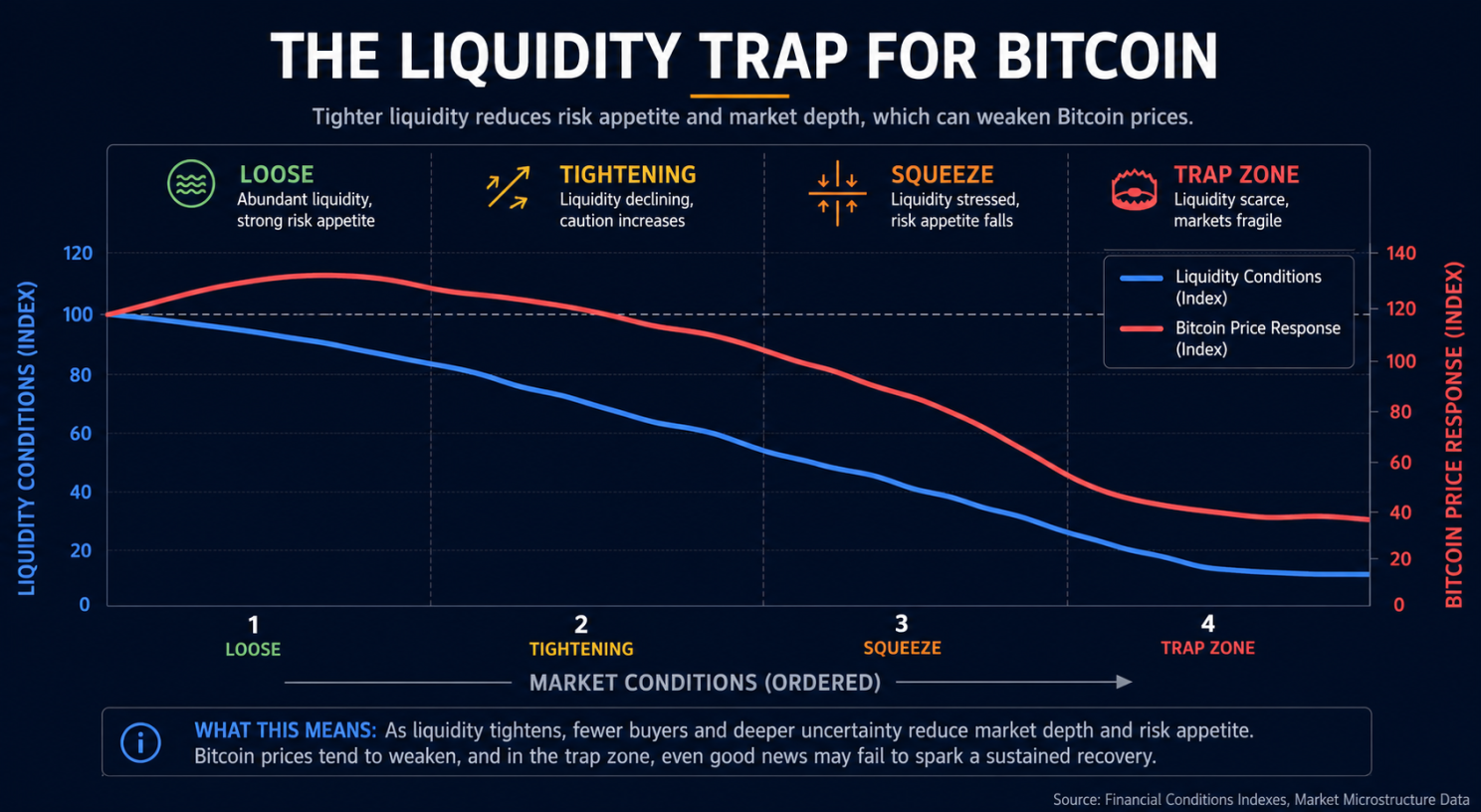
Fig 1. Bitcoin’s liquidity trap: as liquidity tightens, market depth weakens and Bitcoin’s price response turns lower.
The dollar bear market that began in early 2022 appears to have ended as of March 2026. As noted above, a stronger dollar tends to tighten global liquidity, which in turn has historically pressured Bitcoin and other risk assets.
The competition for capital from artificial intelligence
Artificial intelligence (AI) depends on large data centres, specialized chips, and rapidly expanding energy capacity. Its rapid growth over the past five years has drawn investor attention and capital away from digital assets and toward AI.
Bitcoin mining reflects this reallocation of resources. Mining difficulty recently rose 15%, its largest increase since 2021, following an earlier 12% increase after a drop in computing power. Even so, mining economics remain strained: hashprice, or daily revenue per unit of hashrate, is near a multi-year low at about $23.9 per petahash per second [2].
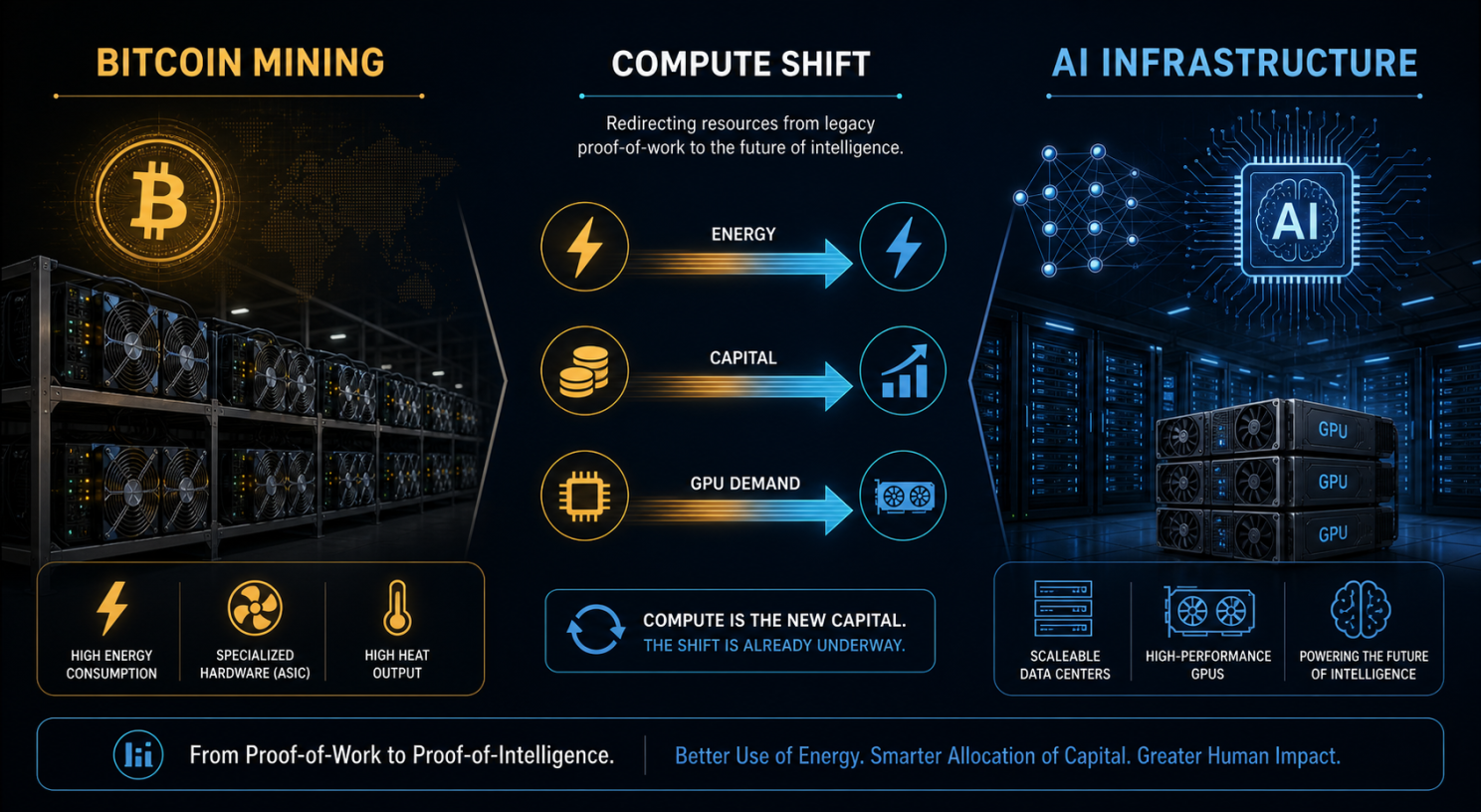
Fig 2. Compute is moving from Bitcoin mining toward AI infrastructure as energy, capital, and GPU demand shift.
At the same time, rising competition, higher energy costs, and lower prices have compressed Bitcoin mining margins. Because miners already operate the data centres and infrastructure needed for AI workloads, many publicly traded mining companies are reallocating energy and computing capacity from mining to AI and high-performance computing. Some have even removed references to Bitcoin as they reposition themselves around AI infrastructure. Examples include IREN, TeraWulf, Cipher Digital, and Riot Platforms [3].
Sentiment
Bitcoin is declining amid broader risk-averse market sentiment and continues to trade in a challenging macroeconomic environment. ETF inflows, regulation, and institutional demand remain supportive, but geopolitical tensions and inflation concerns continue to drive sharp price volatility.
Demand for Bitcoin ETFs remains strong as institutional investors continue allocating capital despite economic uncertainty. These products support Bitcoin’s market structure because new ETF shares must be backed by spot Bitcoin purchases. BlackRock’s iShares Bitcoin Trust (IBIT) remains the main driver of inflows. At the same time, flows are two-way, with outflows occurring when institutions take profits after price rebounds [4].
Another source of optimism is the Digital Asset Market CLARITY ACT, which could establish a clearer regulatory framework for digital assets in the United States. The legislation may reduce compliance uncertainty for financial institutions, pension funds, and asset managers considering exposure to digital assets. Senate Banking Committee discussions have also supported broader digital asset market strength by reinforcing expectations that digital assets will become more integrated into the traditional financial system.
Despite continued volatility, large institutional investors are still accumulating Bitcoin. Many analysts also view Bitcoin as an emerging strategic institutional asset and a portfolio diversifier amid persistent fiscal uncertainty and inflation concerns.
Near-Term Volatility, Long-Term Institutional Validation
In the near term, Bitcoin remains highly sensitive to macroeconomic and geopolitical stress and is likely to continue trading like a volatile risk asset during periods of market anxiety. Even so, its growing acceptance by major institutions marks a significant shift from the skepticism that once defined this asset class. What was once a widely dismissed and even characterized as a fraudulent asset is now increasingly being integrated into the financial system. Despite current headwinds, that institutional adoption suggests Bitcoin’s long-term role as a credible, scarce asset is becoming harder to ignore.
