
Interference: Turning Quantum Possibility Into Direction
After writing about superposition and entanglement, I find myself returning to a quieter but equally important question: how do these two remarkable ideas become useful in computation? Superposition gives a quantum system access to many possible states, while entanglement links those states in ways that defy ordinary intuition. Yet on their own, they do not explain how a quantum computer moves toward a meaningful answer. That is where interference enters the picture. Interference is what brings superposition and entanglement together, shaping the many possibilities within a quantum system so that useful outcomes become more likely before measurement.
The Misunderstanding: “Trying Everything at Once”
To see why interference matters, it helps to begin with a common misunderstanding about quantum computing: the idea that it works by trying every possible answer at once and then somehow returning the right one. Superposition does allow a quantum system to represent many possible states, and entanglement allows those states to become connected in ways that may be difficult to comprehend through classical interpretation. However, a system filled with possibilities still needs a way to distinguish signal from noise, useful paths from useless ones, and meaningful outcomes from accidental ones.
In quantum mechanics, states are described not only by probabilities, but by amplitudes. These amplitudes carry both size and phase, which means they can behave in a wave-like manner. When amplitudes align, they reinforce one another and make certain outcomes more likely. When they oppose one another, they weaken or cancel certain outcomes. Interference does not simply add mystery to the process; it is the mechanism that allows a quantum system to shape probabilities before measurement.
A familiar example is the double-slit experiment. When light, electrons, or photons pass through two narrow openings, they produce a pattern of bright and dark bands. The bright bands appear where wave-like contributions reinforce one another, while the dark bands appear where they cancel. What becomes visible depends not only on the presence of many possible paths, but on how those paths interact. Quantum algorithms use this same logic in a more controlled form: they arrange amplitudes so that paths leading toward useful answers become more likely, while paths leading away from them fade.
A Computational Example: Grover’s Search Algorithm
Grover’s search algorithm offers a useful computational example. Imagine searching for one correct answer hidden among many possibilities. A classical search may need to test candidates one by one. Grover’s method begins by placing the possible answers into superposition, but that alone does not solve the problem. If the system were measured immediately, the result would still be largely random.
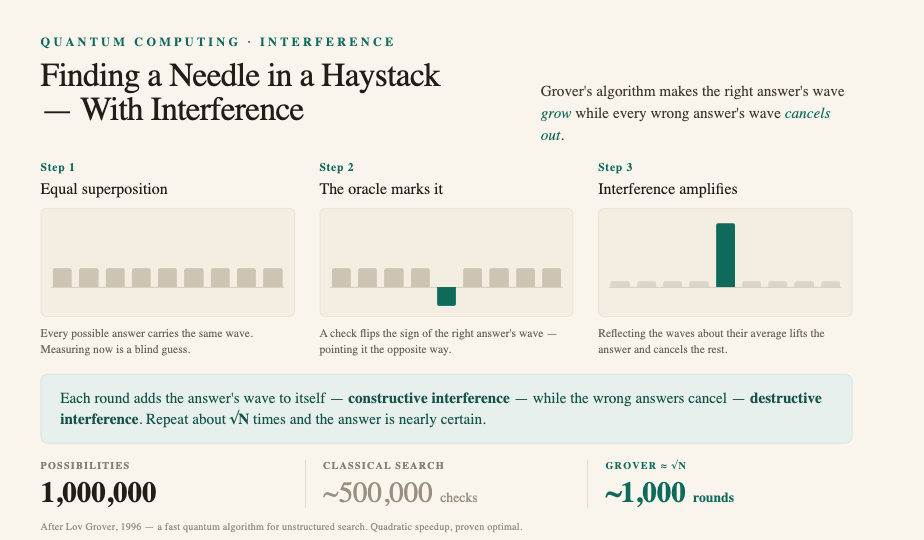
Fig 1. The algorithm finds one answer among many: rather than checking candidates one by one, it tunes the quantum amplitudes so the right answer reinforces itself while the wrong ones interfere away, turning ~500,000 classical checks into ~1,000.
The crucial step is that an oracle marks the desired answer by changing its phase. The oracle does not reveal the answer directly; it simply identifies it internally in a way the rest of the algorithm can use. A later transformation then converts that subtle phase difference into a higher probability of measuring the correct result. Repeated carefully, this process amplifies the desired answer and suppresses the others. The result is not magic and not brute-force parallelism, but rather interference organized into a search procedure.
This distinction matters because quantum computing is often surrounded by inflated language. It is not based on randomness alone, or by vague claims that a quantum state contains every answer. Its power, where it appears, depends on careful control over how amplitudes change over time. Quantum gates do not simply flip values the way classical logic gates do. They rotate, shift phases, entangle, and transform quantum states so that amplitudes interact according to exact mathematical rules. Quantum speedup becomes possible only when a problem has structure that can be built into those transformations and then revealed through interference.
This changes how we think about computation itself. In classical systems, correctness is often achieved through explicit exclusion: start by testing a candidate, reject an invalid branch, compare alternatives, sort a list, or iterate toward a solution. In quantum systems, useful outcomes may instead emerge through reinforcement and cancellation. Some possibilities become more likely because their amplitudes align; others become less likely because their amplitudes work against one another. The solution emerges through the patterns of interaction among possibilities rather than through a process of elimination.
Conclusion: Shaping Possibility Into Probability
For me, this is one of the most beautiful ideas in quantum computing: the right answer is not simply found among many possibilities, as though a machine were reaching into an infinite drawer and pulling out the correct object. Instead, the possibilities must be shaped and curated. Superposition gives the system a wide field of potential states, and entanglement ties parts of that field together so that the state of one part cannot be fully understood on its own. But without interference, these possibilities would remain largely undirected. Interference is what allows the structure inside the problem to become visible.
In that sense, interference is the meeting point between superposition and entanglement. Superposition opens the space of possibilities; entanglement connects those possibilities across the system; interference then decides which patterns grow stronger and which fade away. It lets amplitudes reinforce paths that are consistent with the problem’s structure and cancel paths that lead away from it. The computation works because the system is carefully arranged so that, by the time we measure it, the correct solution has become more likely than the alternatives.
This is why quantum computing should not be described as magic, even when it feels deeply counterintuitive. Its power does not come from containing every answer at once, nor from searching an endless number of possibilities in a literal sense. It comes from the disciplined use of quantum relationships: possibilities are prepared, connected, transformed, allowed to interfere, and only then measured. What appears at the end is not a random gift from an infinite space, but the result of carefully guiding probability, turning quantum possibility into computational direction.
